6 Indoor Christmas Decorations Without a Large Tree
Create a tree-free Christmas with jewel-tone paper decorations, citrus garlands, vintage tableware, a paper village, a card display and an ornament branch.
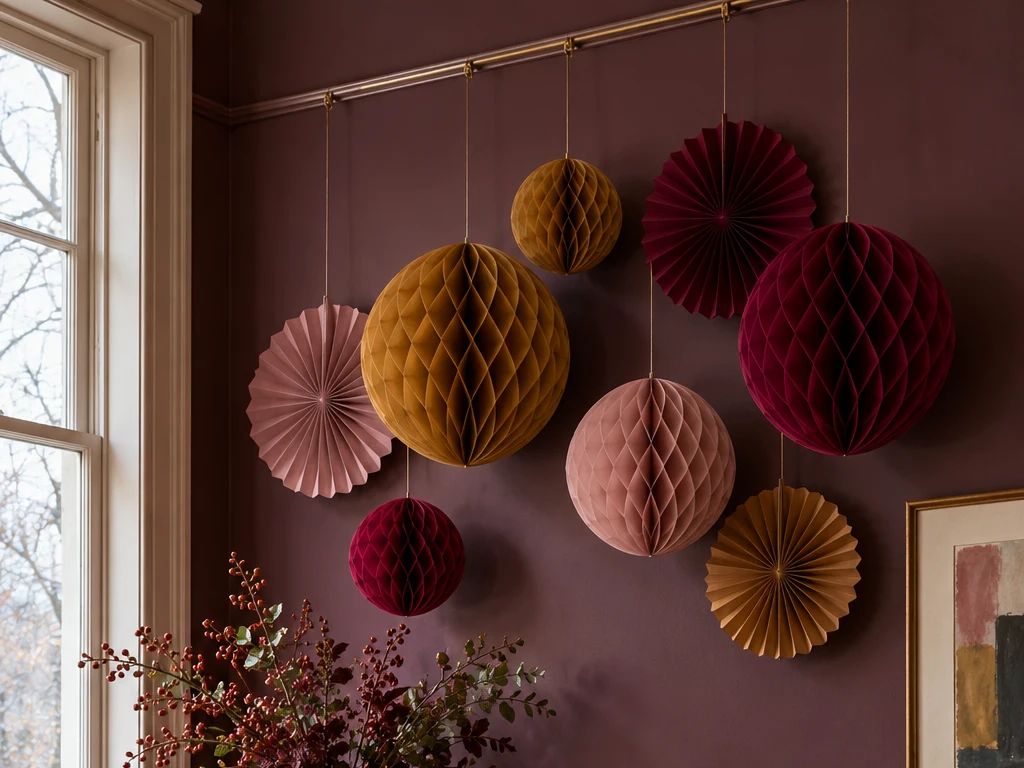
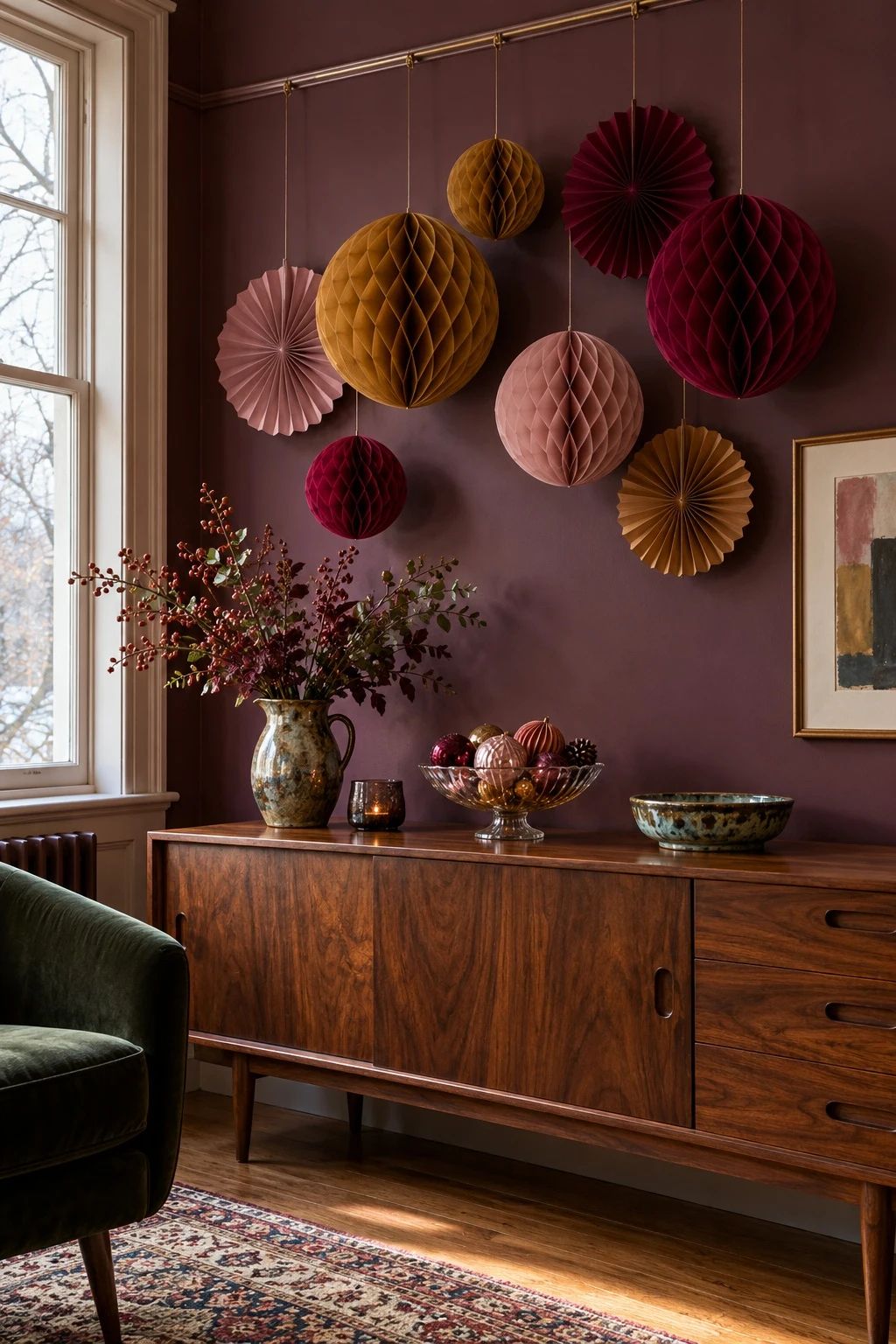
Jewel-colored paper honeycombs and ornaments create a Christmas focal point above a walnut sideboard.
A large Christmas tree usually provides three things at once: height, color and somewhere to gather treasured ornaments. A tree-free room still needs those qualities, but they can be spread through more imaginative displays. Paper honeycombs can bring height above a sideboard; a kitchen garland can carry color; a branch arrangement can give keepsake ornaments a place of their own.
These six indoor Christmas decorating ideas have different moods and different jobs. There is a jewel-toned focal wall, a citrus kitchen window, a table set with collected china, a small paper village, a display of personal cards and a sculptural ornament branch. You can choose one strong story or borrow two that share a color, without making every room look identical.
Choose the view you want to change first: the room seen from the doorway, the window above the sink, the dining table during a meal or a shelf you pass every day. Find one existing object that sets the palette—a blue plate, a pink ornament, an old postcard or a dark vase.
Use appropriate secure hanging points and stable surfaces. Keep decorations clear of heat, working fixtures and required openings; follow light and battery-product instructions. For a real tree instead, the small-apartment Christmas guide covers choosing its footprint.
Plum, pink and ochre paper honeycombs hang above a walnut sideboard with a few jewel-toned ornaments.
Paper decorations can be bold without being expensive-looking or disposable in spirit. Choose a few large honeycomb or folded shapes in plum, dusty pink and ochre, then echo one color in a small group of ornaments on the sideboard. The mix of matte paper and reflective glass gives the display depth. A darker wall makes the paper shapes stand out instead of blending into a pale background.
Arrange the largest shape first, offset from the furniture’s center. Add smaller forms at different heights and leave visible wall between them. Hang them from appropriate independent fixings suited to their weight; the photograph is not a reason to attach decorations to a light fitting. Below, keep the reflective pieces in one low group and retain a practical portion of the surface.
If your room is light and neutral, keep the jewel colors but use fewer forms so the display reads as a confident accent. Choose shatter-resistant ornaments where the household needs them. Flat-folding paper decorations can pack away compactly, provided they are kept dry and handled according to their construction. This is a color story first, not a requirement to buy a complete matching set.
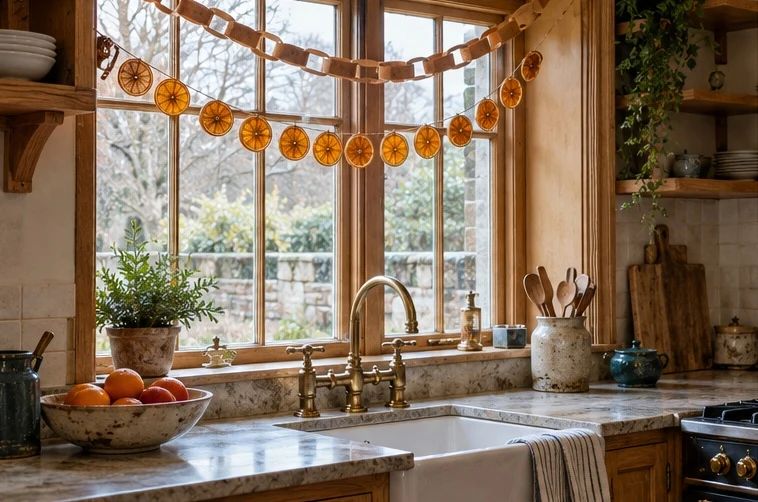
Dried citrus and a kraft-paper chain bring amber and warm brown to a timber kitchen window.
A garland of dried citrus and a separate paper chain can make a kitchen window feel festive through color and repetition. Amber slices work well with honey-colored timber, stoneware and a few everyday copper details. Unlike a large wreath, the repeated small shapes create a line across the view while leaving much of the glass open.
Lay the garland out before hanging it and alternate open spaces with short groups of slices. Keep the paper chain as a simpler second line rather than intertwining every link with the fruit. Use fully dried decorative material, appropriate lightweight attachments and a position that leaves the handle, blind and opening available. Keep paper away from cooking heat and damp areas.
You can replace citrus with reusable felt shapes if fruit will not suit the room, but retain the warm amber-and-brown relationship. On a white window frame, a darker string can make the pattern easier to see. The idea is a handmade rhythm that belongs beside your everyday kitchen objects, not a row of identical store displays across every window.
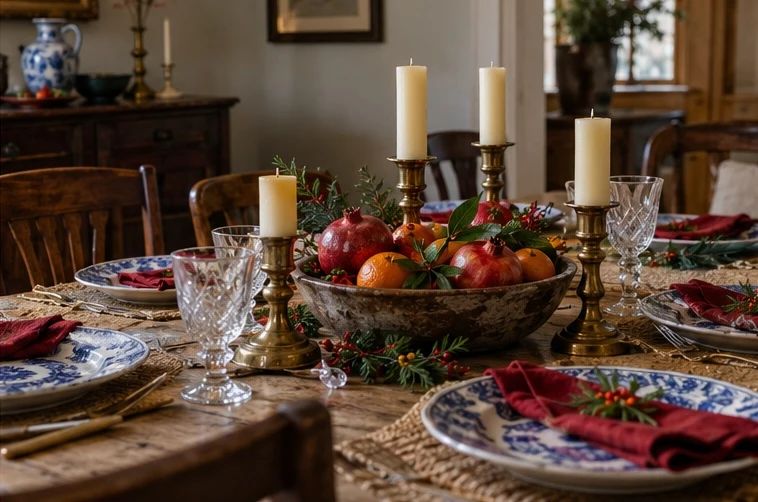
Collected blue-and-white plates, ruby napkins and a low fruit arrangement make a layered holiday table.
Blue-and-white china offers a useful alternative to a new festive dinner service. Let the plates carry the detailed pattern, then add ruby cloth napkins and a low bowl of winter fruit for color. Clear glasses and a little aged brass keep the setting from becoming a wall of competing patterns. The result feels collected because each material does a different job.
Start with the plates you own and choose one plain textile that picks up a small color in the pattern. Keep the center low enough for conversation and test the arrangement with the actual serving dishes. If you use LED candlelight, separate it from food and keep the equipment accessible. Decorations that need constant moving are not helping the meal.
Mixed plates can work if they share a blue range or repeated border shape. On a tiny table, reduce the centerpiece to one bowl and let the napkins supply the red. The winter table guide offers quieter alternatives; here the point is to give familiar china a distinctly Christmas color relationship without buying themed plates.
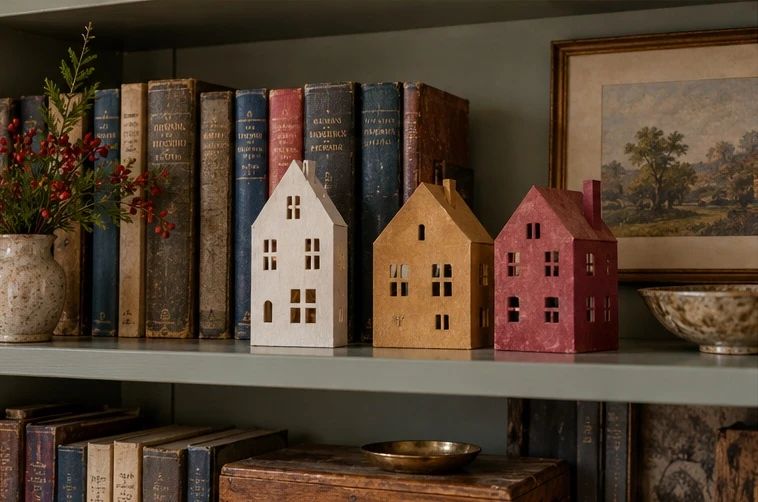
A small village of paper houses sits among books, with one repeated ochre-and-red palette.
A paper village becomes more personal when it lives among books and objects rather than on a newly bought display table. Keep the houses in a small related palette—warm white, ochre and faded red—and let their roof shapes make the variation. A few houses at different heights can suggest a street without filling an entire wall with tiny props.
Clear one shelf and begin with the largest house. Use stable low supports behind smaller pieces where needed, then leave breaks in the row so the arrangement can be read. If making houses, start with a reliable paper template and choose paper suited to the construction. The article’s photograph is a styling example, not a measured cutting pattern.
Keep the village unlit unless its components are designed for the lights you intend to use. Paper beside a flame is not a decorating shortcut. Replace a few houses with wooden or ceramic pieces you already own if their scale works, and preserve access to books. A limited village is easier to enjoy at close range than a dense collection that turns every shelf into storage.
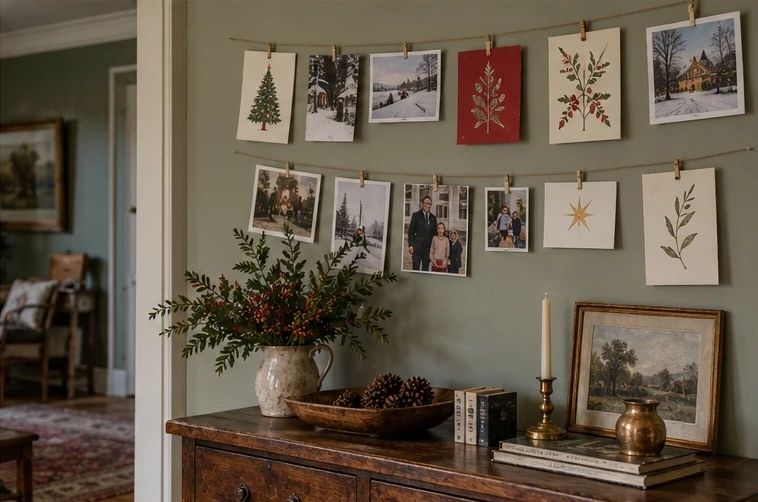
Illustrated cards and small family photographs hang from two short clipped lines against a sage wall.
Personal paper gives a room a kind of detail that purchased ornaments cannot reproduce. Use a short section of an existing suitable picture rail or a stable wall-mounted display to show a changing edit of Christmas cards and old photographs. Their different edges and image styles make the display feel collected, while a repeated clip finish keeps it coherent.
Lay the selection on a table first. Alternate taller and wider cards, then include a few photographs that contribute a memory rather than simply matching the palette. Keep the lines short enough that the pieces hang visibly rather than forming a crowded curtain. Use appropriate secure attachments and keep clips and trailing lines out of reach where they could cause a problem.
If you would rather not expose original photographs, use copies and store the originals properly. The images in the illustration are generic examples, not real family records. A single red ribbon or a few small paper stars can connect the display to the season, but let the cards remain the main subject. Add new arrivals gradually instead of covering the entire wall at once.
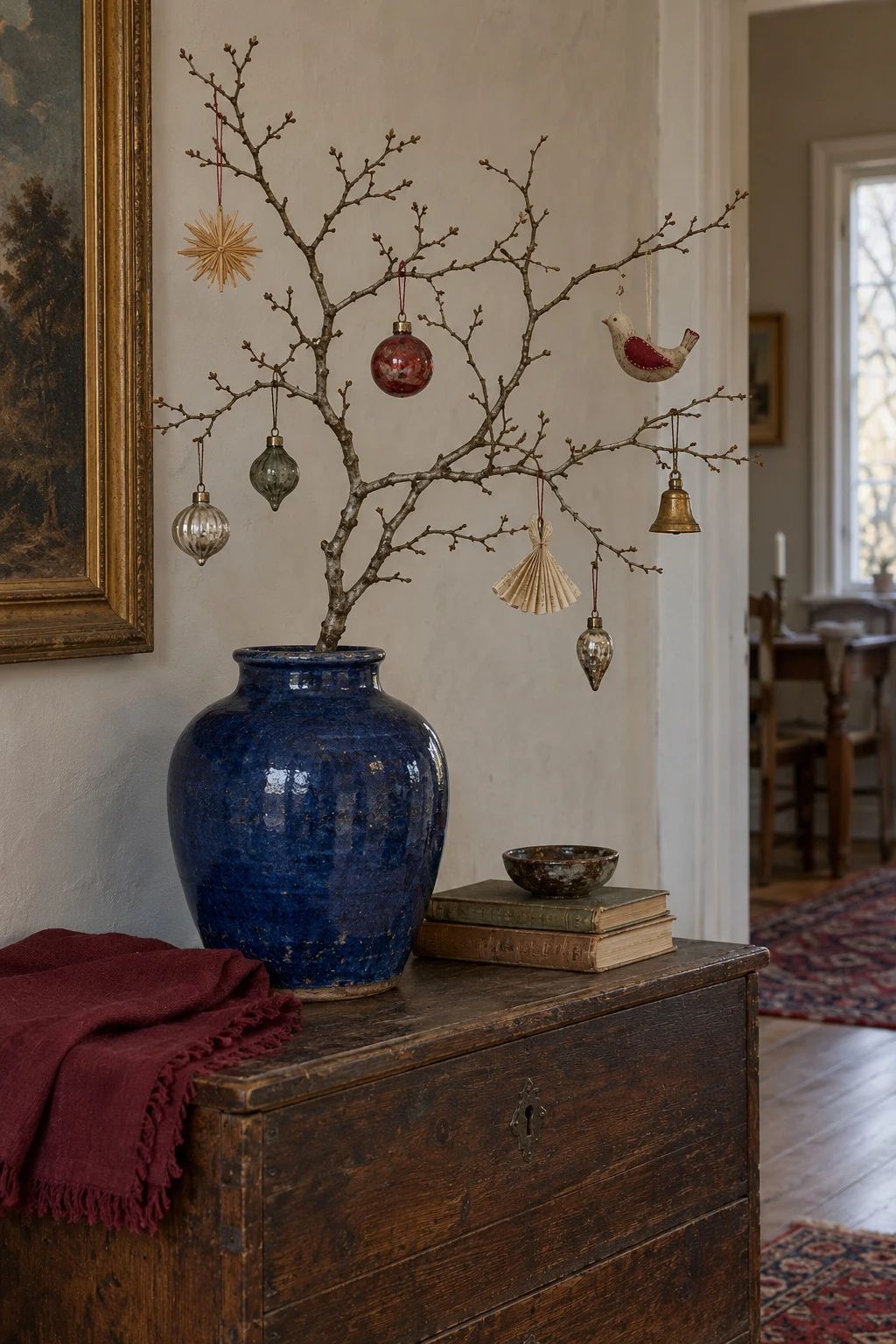
A securely supported bare branch carries a few colored ornaments above a blue ceramic vessel.
A bare branch can offer the height and ornament display of a tree without occupying the same footprint. Choose a stable vessel and a branching shape that opens outward rather than forming a dense bundle. A deep blue pot, a little burgundy and a few varied ornaments create a strong silhouette against a light wall; the empty space around each ornament becomes part of the arrangement.
Establish a stable appropriate support inside the vessel before hanging anything. Test the branch and total balance, then begin with the heaviest suitable ornament near a strong lower junction. Use lighter pieces farther out and keep the ornament count modest. A pretty narrow-necked vase is not automatically a safe stand for a top-heavy branch.
Choose a location away from the route through the room and use durable ornaments where needed. If you cannot make the support reliably stable, a purpose-made tabletop display is the better option. A few objects with different histories can look richer than a large matching box; the arrangement should feel like a place for things you enjoy, not a reduced copy of a department-store tree.
Tree-free decorating becomes more interesting when each display has a distinct role: a color statement, a handmade line, a meal, a miniature street, a collection of memories or a sculptural silhouette. Choose the two ideas that feel most like your home, then connect them with one color or material rather than repeating the same decoration in every room.
Explore six distinctive Christmas door decorations, from copper-bell garlands to citrus wreaths, woven baskets and twig stars, with recipes for each look.
Style a small Christmas porch with six distinct schemes, including tartan, blue-and-white pots, citrus, vintage sleds and layered evening lantern light.
May we use Google Analytics cookies to understand visits and which ideas readers find useful? It is optional. You can change your choice below at any time. Privacy details