6 Christmas Door Decorations with Color, Texture and Character
Explore six distinctive Christmas door decorations, from copper-bell garlands to citrus wreaths, woven baskets and twig stars, with recipes for each look.
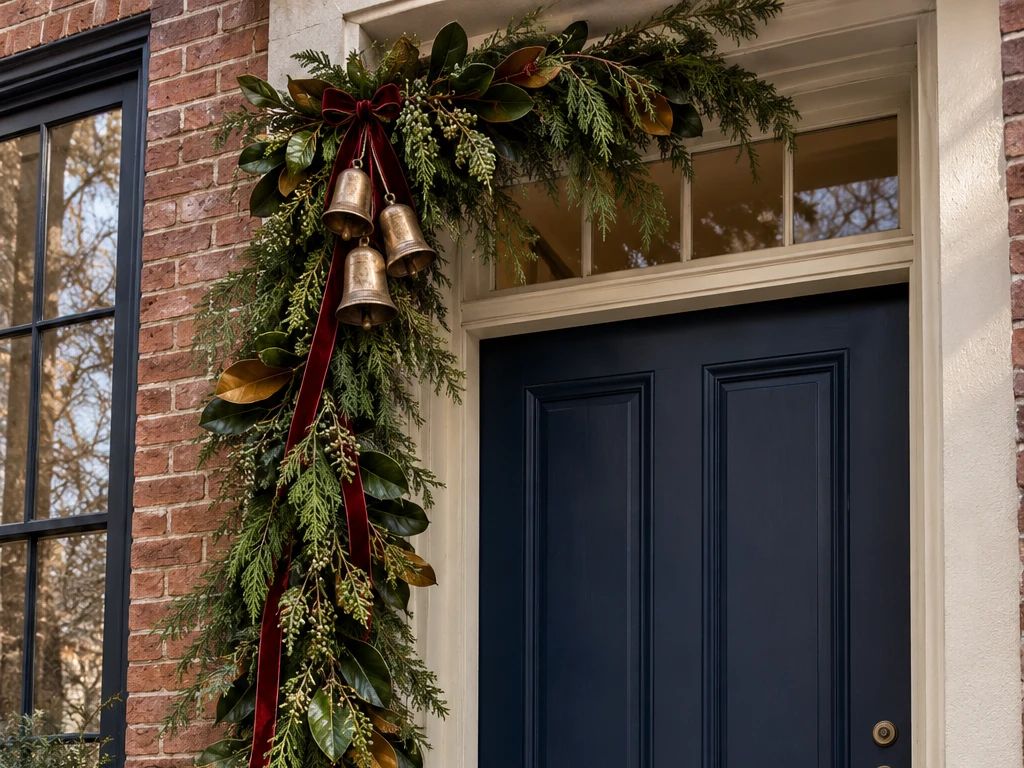
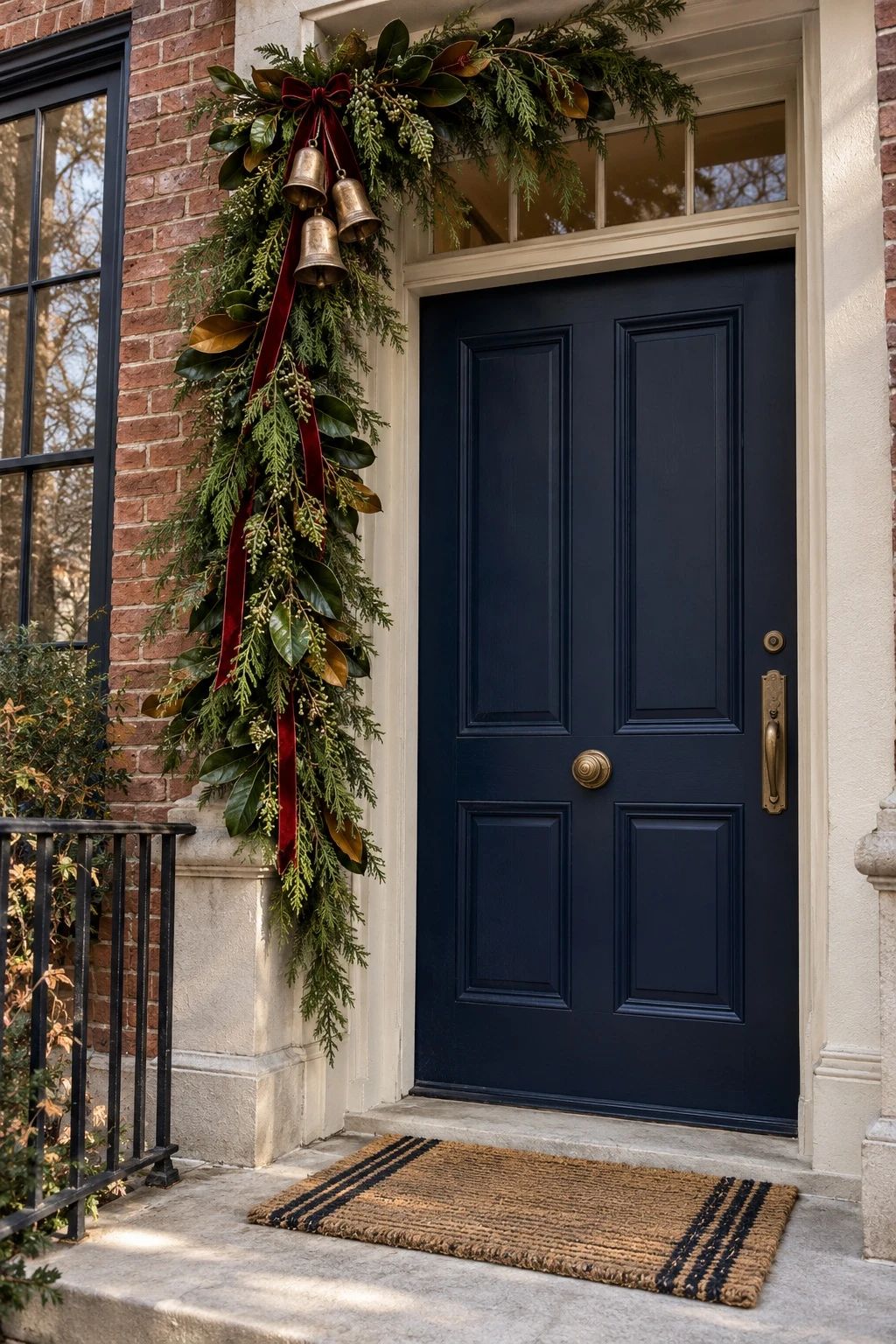
An asymmetric cedar garland and copper bells frame a midnight-blue Christmas front door.
The most memorable Christmas doors have a clear idea behind them: a sweep of greenery that follows the brickwork, translucent orange slices against a painted panel, or a twig star whose outline can be read from the path. They do not all need the same round wreath and red bow. Shape, material and the door color can each become the starting point.
These six Christmas door decorations move between collected traditional, citrus-bright cottage, graphic, botanical, woven and rustic styles. Each has a different outline and a specific recipe for building the look. Choose a direction that complements your existing door, then adapt the scale and materials; repainting the entrance is not part of the project.
Take a straight-on photograph of the door and note its color, panel arrangement and visible hardware. Choose the main silhouette first: a frame around the opening, a circular shape, a vertical stack, a half-ring, a basket or a star. A dark door brings out pale twigs and copper; a light door makes deep foliage and a repeated ribbon easy to read.
Before installing anything, confirm permitted attachment points, surface compatibility, total weight and weather exposure. Leave the lock, handle, viewing hardware and door movement usable. Dried fruit, fabric and natural foliage need a location suited to their condition and care; follow your actual products’ instructions.
Cedar sweeps around one upper corner of a navy door, with copper bells grouped at the bend.
Instead of outlining all four sides of the opening, let the garland travel across part of the lintel and down one jamb. The unequal lengths make the composition feel like a growing branch rather than a rigid rectangle. On a navy door, copper catches the light while the fine cedar foliage softens the hard brick edge. Keep the opposite side relatively quiet so the asymmetry remains obvious.
Start with the supporting garland, establish the upper bend, then extend the longer drop. Place your densest foliage near that bend and taper the lower end with smaller sprays. Group a few copper-colored bells close to the corner rather than spacing identical ornaments down the whole length. Thread in narrow oxblood ribbon as short accents. The fixing system must support the greenery and bells independently of the decorative ribbon.
For a smaller entrance, shorten both arms of the arrangement and keep the same unequal proportions. For a lighter door, use brown magnolia leaf backs to retain some visual weight. If the frame cannot take an appropriate fixing, translate the same cedar-and-copper palette into a smaller door-mounted arrangement instead of improvising an attachment.
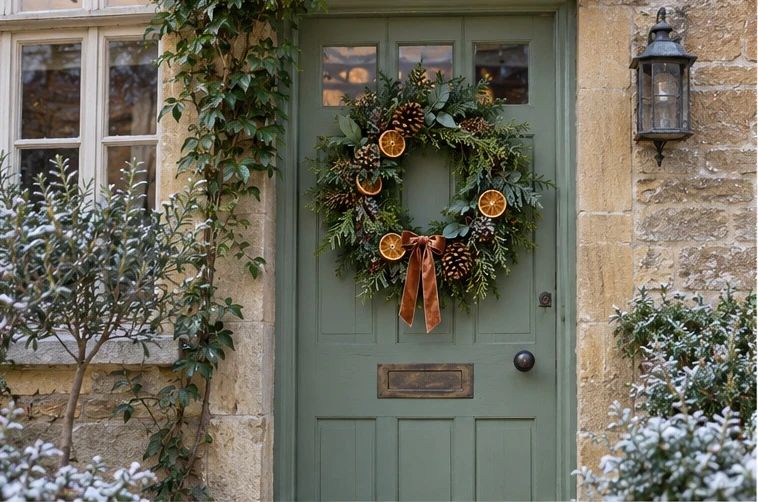
A citrus-accented wreath on a sage door uses amber orange slices, glossy leaves and a copper-toned tie.
Dried orange slices contribute a translucent amber color that ribbon cannot quite reproduce. Set them against darker foliage so the centers and pale rind edges remain visible. A sage-painted door gives the arrangement a softer background than bright white, but the same mix works against cream, charcoal or natural wood. The important contrast is light fruit against dark leaves.
Build around an existing suitable wreath base or a ready-made plain foliage ring. Lay the orange slices out before attaching them: use an uneven group on one side, then repeat a smaller group elsewhere rather than creating an exact clock face. Tie the slices on through sound attachment points with suitable fine ties, without crushing them. Add a small copper-toned ribbon knot and let the foliage remain the largest material.
Use fully dried decorative slices and inspect them for deterioration; this is an ornamental arrangement, not food storage. A protected entrance is a better home for delicate dried material than a rain-exposed door. For a fruit-free variation, replace amber slices with a few small matte ochre ornaments while keeping the dark foliage and sage relationship.
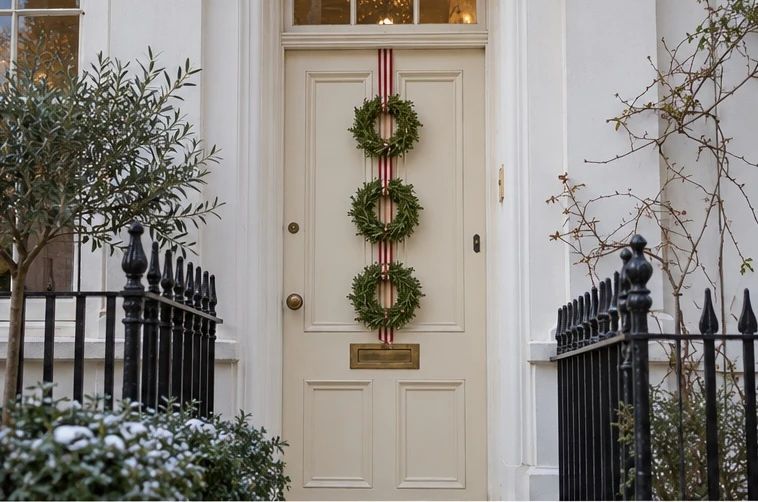
Three small wreaths form a graphic vertical stack on striped ribbon against an ivory door.
A stack of small wreaths has a different rhythm from one large circle. Against an ivory door, a red-and-cream striped ribbon gives the green rings a graphic spine. The wreaths can be close in size without being identical: the repeated outline does most of the work. This treatment suits a tall uninterrupted panel better than a door filled with small windows.
Arrange the wreaths flat first and adjust the spacing until each reads as a separate circle. Measure the finished stack against the usable part of the door, then shorten the ribbon or use fewer rings if necessary. Attach each wreath securely to the backing or hanging system; a loose decorative bow should not carry the entire arrangement. Finish the top with a plain tie rather than a fourth competing ornament.
Choose small reusable faux wreaths if your entrance and product guidance make them appropriate, or use modest fresh rings and accept that their condition will change. The striped ribbon can become navy-and-ivory for a cooler scheme. On a shorter door, two rings preserve the idea better than squeezing in a third beside the handle.
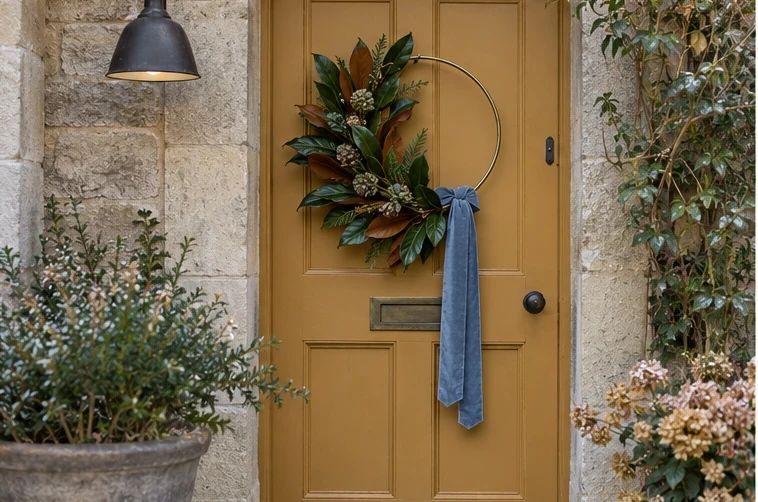
Magnolia leaves occupy one side of a slim hoop, with dusty-blue ribbon against an ochre door.
A half-wreath leaves part of its supporting ring exposed, so the empty arc becomes part of the design. Magnolia is particularly expressive here: its broad green faces and brown undersides make a visible change of texture without a large ornament collection. A dusty-blue ribbon against an ochre door creates a more unexpected pairing than the usual red and green.
Choose a suitable hoop and arrange foliage along one side before fastening it. Keep the leaves facing in a related direction while allowing some brown backs to show. Make the fullest point slightly below the middle of the covered arc and taper both ends, so the foliage feels intentional rather than unfinished. Wrap and conceal the structural ties; add the ribbon only after the leaf arrangement holds securely.
A dark hoop makes the bare arc clear on a pale door. On a dark door, choose a hoop finish that stays visible rather than disappearing into the paint. If magnolia is not available, a reusable broad-leaf arrangement can carry the shape, but check that the substitute is suitable for the location. Keep the half-circle: changing the entire silhouette would lose the point of this look.
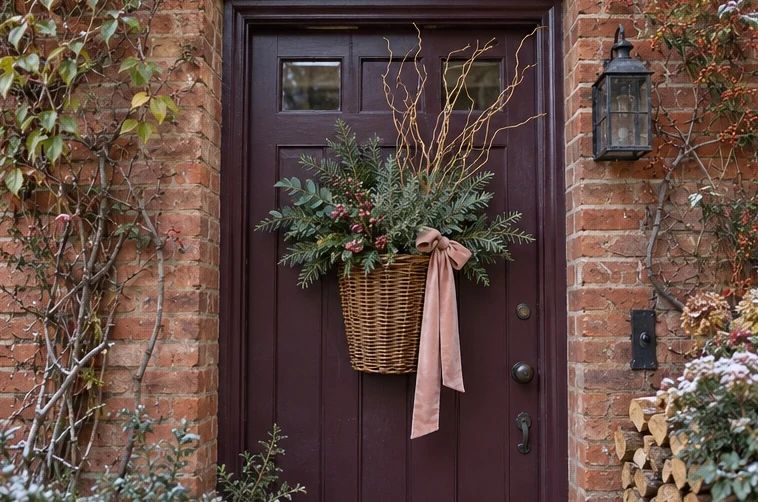
A shallow wicker door basket carries fir and curly willow against a plum-painted door.
A shallow basket changes the decoration from a flat shape into a small gathered arrangement. On a plum door, pale wicker, green fir and slender willow have distinct tones and textures. The upright stems extend the outline while the basket gives it a grounded base. A short blush tie keeps the palette gentle without turning the whole arrangement pastel.
Use a basket designed to hang flat rather than a deep shopping basket that projects awkwardly from the door. Start with a stable appropriate insert or structure inside it, establish a few taller stems at the back, then add shorter evergreen sprays around the rim. Keep the center varied rather than perfectly conical. The basket, insert and foliage together determine the load on the fixing.
This is a good look for a protected door with enough depth around the attachment. If the door sits behind a close-fitting storm door, select a flatter treatment instead. A darker basket and burgundy ribbon can shift the same idea toward a more traditional entrance. For a coordinated approach beyond the threshold, see the six porch schemes rather than repeating the basket on every surface.
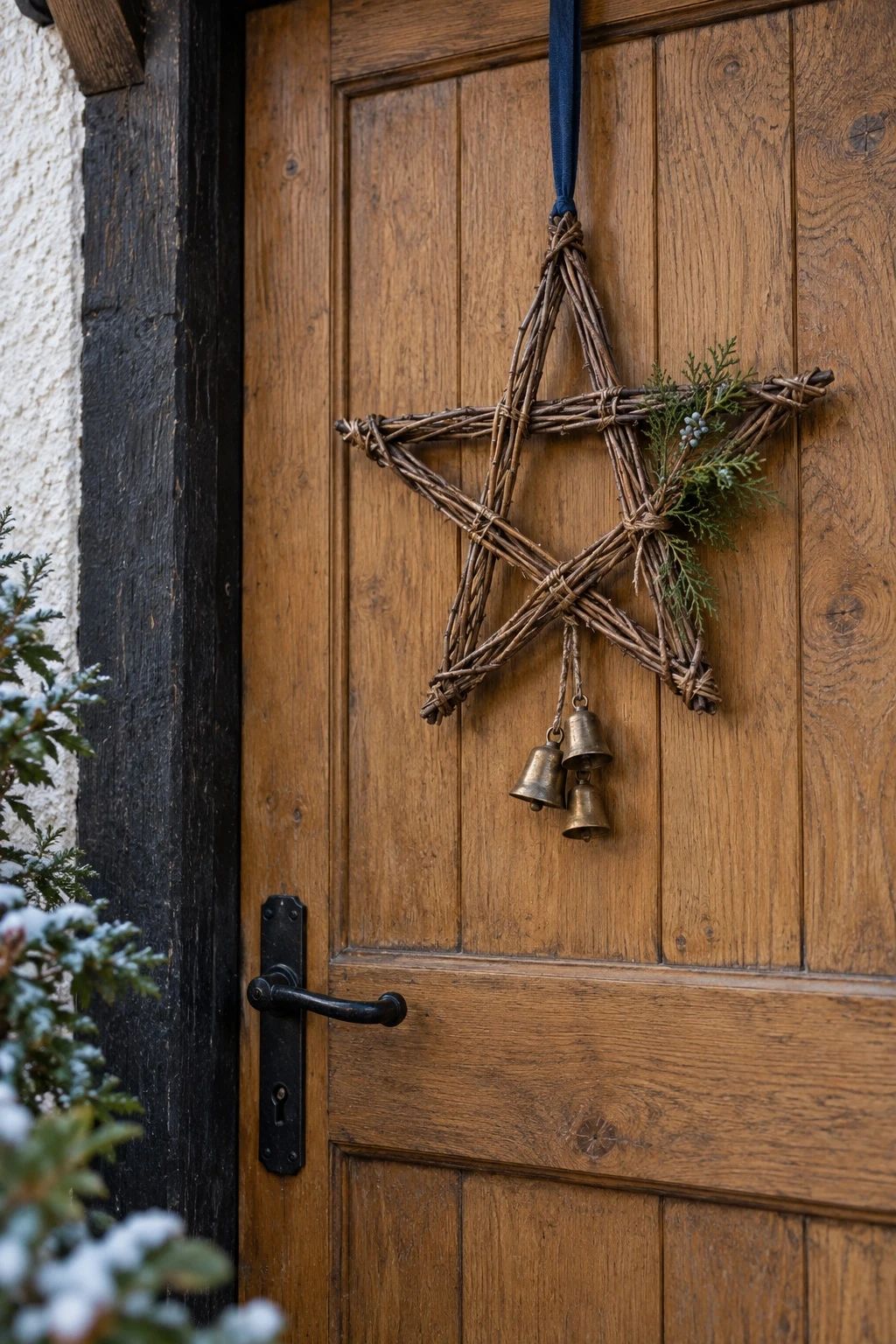
A handmade willow star, aged brass bells and an indigo tie add texture to an oak door.
A twig star provides strong geometry without a circle of foliage. Against warm oak, the overlap of slender stems and a few aged-brass bells can carry the whole decoration. The indigo ribbon adds a cooler note that separates the star from the door’s brown grain. This is a particularly useful direction when the wood itself is worth keeping visible.
Begin with a sound ready-made twig star or construct one using an established suitable method and secure all joins. Check its shape flat on a table: slightly uneven stems can look natural, but loose intersections are not a styling detail. Bind a few small cedar sprigs into one side and suspend a small bell group from a lower point. Keep sharp ends contained and the completed piece clear of the handle.
For a pale door, deepen the twig tone or use darker ribbon to make the outline readable. Resist filling every opening with ornaments; the negative spaces define the star. Carry the indigo or brass inside through one object from the tree-free Christmas collection, rather than making the entire house match this exact arrangement.
Decide which outline suits your entrance before choosing individual ornaments. An architectural garland, fruit-lit circle, repeated rings, half-hoop, woven basket and open star tell six different stories. Keep the story clear, and the door can feel personal even when much of the material comes from a box you already own.
Style a small Christmas porch with six distinct schemes, including tartan, blue-and-white pots, citrus, vintage sleds and layered evening lantern light.
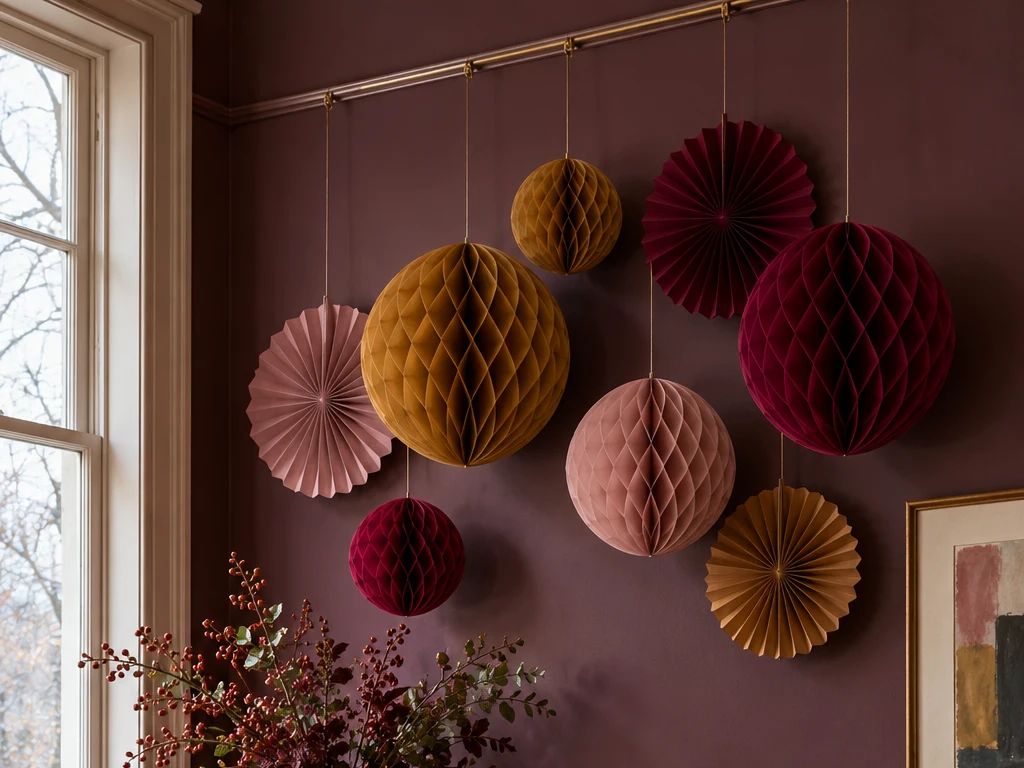
Create a tree-free Christmas with jewel-tone paper decorations, citrus garlands, vintage tableware, a paper village, a card display and an ornament branch.
May we use Google Analytics cookies to understand visits and which ideas readers find useful? It is optional. You can change your choice below at any time. Privacy details