Declutter seven useful categories before the New Year, with clear keep-or-pass-on decisions and responsible routes for clothes, electronics and medicines.
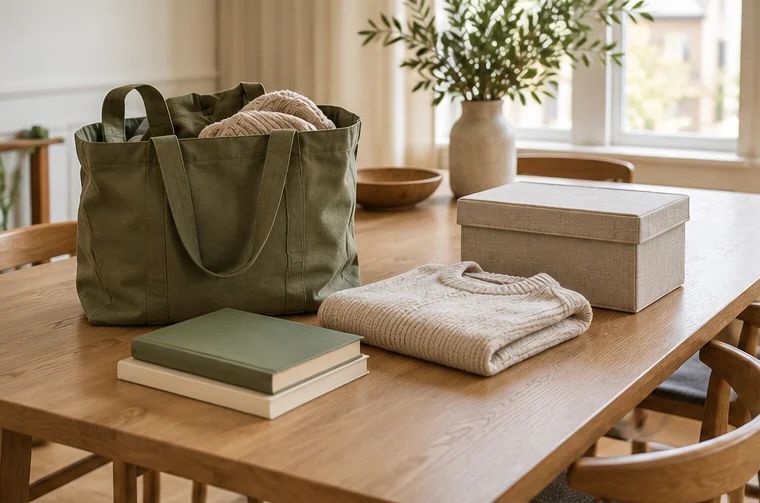
Donation tote, books and folded sweater on an apartment table
The most useful things to declutter before the New Year are often the small categories you handle repeatedly: a drawer that jams, a box of mystery cables, a cupboard with several half-used versions of the same product. Clearing one of these can improve everyday life without pulling apart the whole home.
Choose one category per session, and identify its exit route before you start. Keep a place for recycling, a bag for suitable donations and a small area for items requiring special disposal. A deadline can help you finish, but December 31 is not a reason to discard something useful, abandon it outside a charity shop or throw unfamiliar chemicals into the bin.
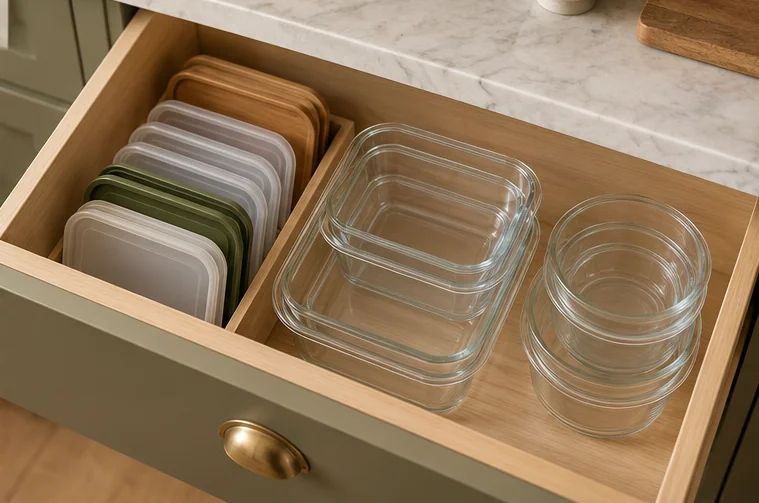
Nested food containers and matching lids in a kitchen drawer
Bring together one food category at a time: baking supplies, breakfast foods or tinned ingredients. Keep packages with essential labels intact and move the items that need using first toward the front. Write two realistic meals around what you already have before buying ingredients for a new plan.
Check storage directions and relevant dates. Date-label meanings vary by country and product, so follow your local food-safety guidance rather than treating every date as interchangeable. Do not taste food to determine whether it is safe, and discard leaking, bulging or otherwise unsafe packages. A pantry clear-out is not an invitation to take a chance.
Ask a local food bank what it currently accepts before putting food into a donation bag. Open packets, home-prepared foods and items beyond its accepted dates may be unsuitable. If a perfectly usable ingredient simply does not suit your cooking, offer an eligible unopened package promptly instead of storing it through another year.
Finish the food-storage pass by pairing empty containers with their lids. Keep a manageable nested set that fits its drawer, and check the markings and manufacturer guidance before reusing containers for freezing or heating. An unmatched lid does not need another year of cupboard space.
Work through a contained category, such as winter knitwear or everyday trousers. Ask whether the garment fits comfortably, suits your current life and is something you choose when it is clean. Keep necessary seasonal clothing even if it has not been worn recently; a raincoat has a different role from an everyday shirt.
Separate repairable pieces from clothes you are ready to pass on. Give repairs a practical next action, such as sewing a missing button this weekend or getting a quote for a zip. Keeping a large pile of theoretical mending can make the wardrobe harder to use without saving the clothes.
Donate clean, dry, wearable garments only through a service that accepts them. Check textile collection rules for worn or damaged pieces; a collection bin is not evidence that everything placed inside will be recycled. Keep one useful cleaning rag if needed, rather than converting an entire bag of unwanted clothes into a new category of clutter.
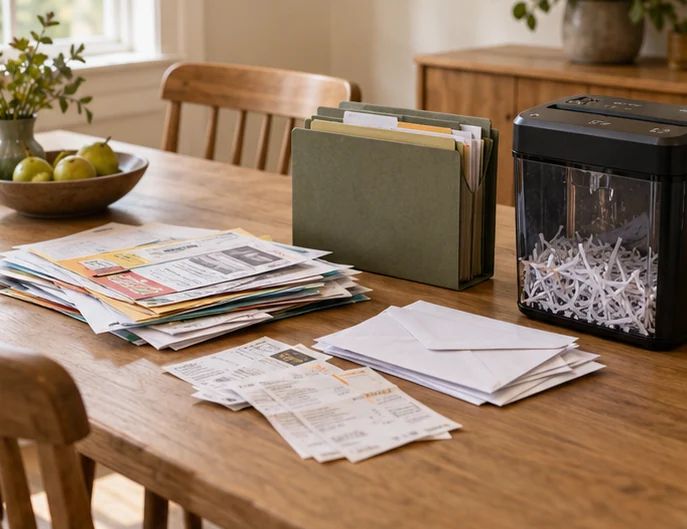
Paper sorting on a dining table with blank envelopes, action folder and compact shredder.
Start with obvious low-risk paper: duplicate printouts, outdated menus, empty envelopes and instructions for things you no longer own. Then separate documents that require action from records that need retaining. A small action folder is more useful than leaving a bill in a pile and hoping its position will remind you.
Do not apply a blanket keep-for-one-year rule to financial, property, medical or legal records. Retention depends on the document, jurisdiction and circumstances; the IRS guidance, for example, describes several different US tax-record periods. Check the appropriate authority or adviser when you are unsure, and keep identity documents and essential originals secure.
Shred sensitive paper when you have confirmed it can go. If digitizing, check that the scan is complete, readable and backed up before destroying a permitted original. Give the digital file a useful name and folder. A photograph among thousands of camera images is difficult to retrieve when you actually need the record.
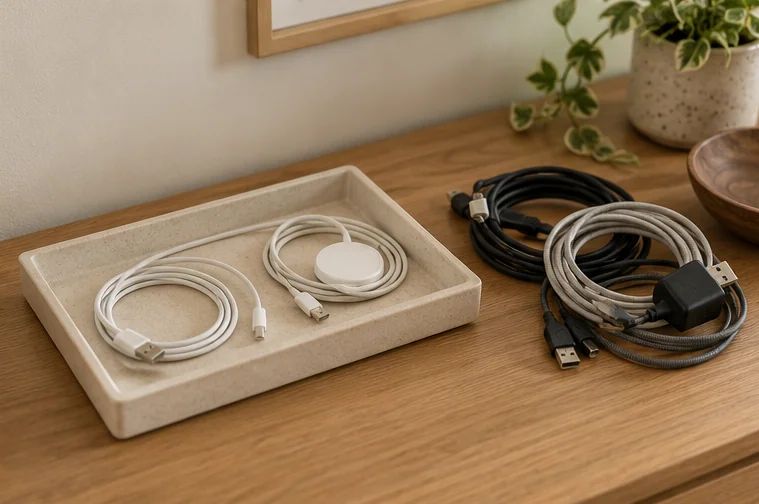
Coiled charging cables beside a shallow sorting tray
Lay the cables out beside the devices they might serve, and test only equipment that is safe to use. Label the working cable for an active device. Keep a limited set of useful spares and separate obsolete connections. You do not need to identify every historical charger before deciding that it no longer serves your household.
For a working phone or computer, check manufacturer instructions for backing up, signing out and securely removing personal information before donating or recycling. A normal file deletion may not be an adequate data-removal method. Check what the recipient needs, including chargers, and confirm the device is accepted.
EPA advises that lithium-ion batteries and electronics containing them belong outside ordinary household rubbish and curbside recycling. Use a suitable local collection route. Do not pry out a sealed battery; follow manufacturer and collection-site instructions, particularly for damaged or swollen batteries. Keep the disposal task small enough to complete safely.
Separate small group of medicine containers in original opaque packaging beside unopened toiletries.
Review medicines separately from cosmetics. Check expiry dates, storage instructions and whether an old prescription is still part of your current treatment. Ask your pharmacist or clinician about uncertainty; do not stop prescribed medicine simply to clear a shelf. Keep useful medicines in their labeled packaging and stored securely.
Use the locally approved medicine-return or take-back route where available. FDA guidance prefers take-back for most unused medicines and gives specific alternatives when that is unavailable. Do not broadly flush medicines or donate them to a charity collection. Sharps require their own approved container and disposal route.
For toiletries, discard products that are contaminated, have changed unexpectedly or are beyond their stated usable period. Offer suitable unopened products only to an organization that accepts them. Avoid keeping a product that irritates your skin because it was expensive; a smaller cupboard of items you can actually use is the practical goal.
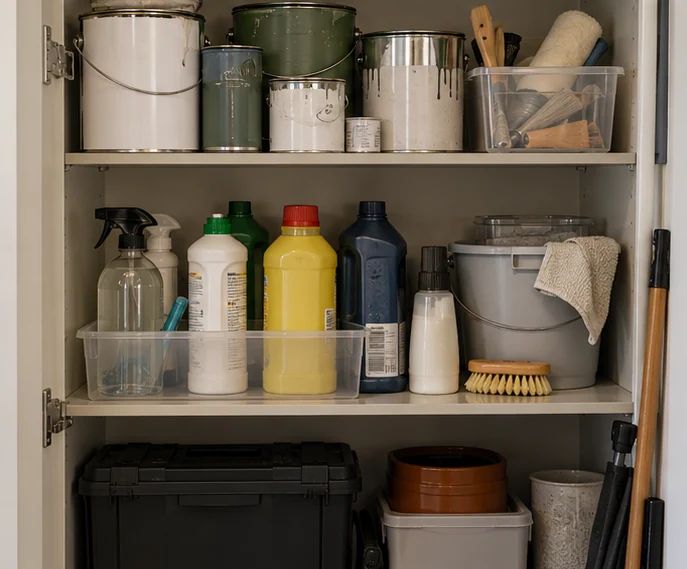
Household utility cupboard with upright original paint tins and cleaner containers safely separate.
Check the utility cupboard for duplicates, unidentified bottles and products left from old projects. Keep useful supplies in their original containers with readable labels, separated from food and secured appropriately. Never combine half-empty cleaners to make more room; products can react dangerously when mixed.
Some paints, solvents, pesticides and household chemicals need a special collection route. EPA recommends checking local household hazardous-waste arrangements and warns against pouring these materials down drains, onto soil or into storm sewers. Exact rules vary, so look up your local service before loading everything into a car.
Keep usable paint only when it matches something you still need to maintain and has been stored appropriately. Label its room, finish and date without covering safety information. Offer suitable excess through an approved reuse scheme where available. Clear labels and a known purpose matter more than retaining every tin from a former home.
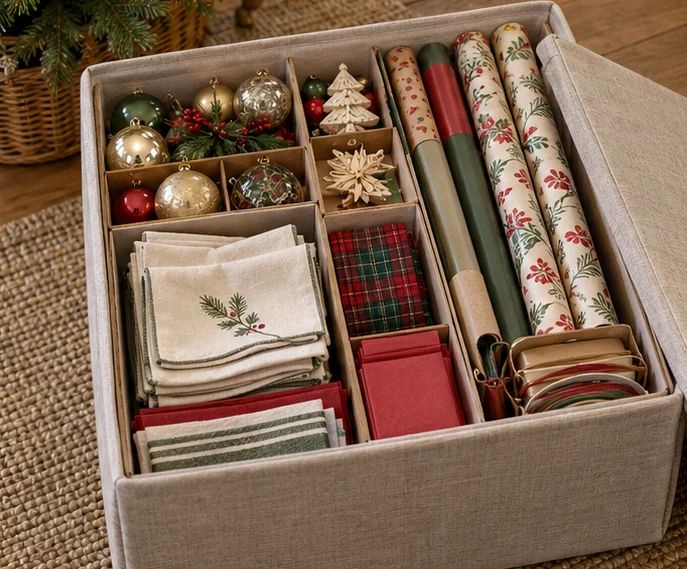
Open seasonal storage box divided for ornaments, folded wrapping paper and serving napkins.
Review seasonal supplies while they are still accessible. Check whether a decoration is used, sound and appropriate for your current space. Keep a small number of meaningful pieces even if they are not displayed every year; the decision is about the object’s place in your life, not an arbitrary minimalist quota.
Sort incomplete games, surplus wrapping materials and duplicate serving pieces into useful groups. A complete, usable set is easier to pass on than a box of mismatched remnants. Offer suitable seasonal items before demand passes, and confirm the recipient wants them rather than arranging an unsolicited drop-off.
Do not automatically replace everything you remove. Photograph the contents of a stored box and note genuine gaps for next year. If you only used a small selection, a smaller container may be enough. End the session by arranging collection, donation or disposal; moving the box to another room is an unfinished decision.
A useful clear-out leaves fewer unresolved decisions behind. Choose one category, check the appropriate destination and finish that route before opening the next cupboard. For storage that will stay manageable afterward, use the access and capacity checks in our small space organization guide. Once the outgoing items have left, choose one small change from the January home refresh guide rather than immediately refilling the space.
Seven small space organization ideas built for everyday use, with practical storage choices, access rules and simple ways to prevent clutter returning.
Try five January decorating ideas after the holidays: pack thoughtfully, clear everyday surfaces, clean awkward corners and refresh the room with what you own.
Seven January journal prompts for a thoughtful fresh start, helping you carry forward what works, recognize your capacity and choose a small next step.
May we use Google Analytics cookies to understand visits and which ideas readers find useful? It is optional. You can change your choice below at any time. Privacy details